

L298N Motor Driver Board for Arduino & Raspberry Pi DC and Stepper Motors
SKU 9F-RLTT-KUYL
Dual H-bridge motor driver for Arduino and Raspberry Pi, great for controlling 2 DC motors or 1 stepper motor.
Each pack contains the selected number of the same product, bundled together. For example, a 4-Pack contains 4 of the product shown.
Bulk eligible
Mix any Bulk eligible products — discount applies to your total quantity across the cart.| Buy 5+ | $6.55 each | Save 5% |
| Buy 10+ | $6.21 each | Save 10% |
- Free Ground Shipping U.S. orders $35+
- Ships from USA Worldwide via DHL
- 30-day returns Free defect replacement
- 7-day support Fast email replies
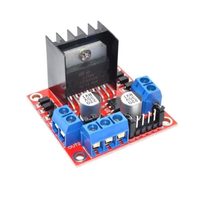 L298N Motor Driver Board for Arduino & Raspberry Pi DC and Stepper Motors
★★★★★
(26)
$6.90
This item
 ULN2003 5V 4-Phase Stepper Motor with Driver Board for Arduino, Raspberry Pi & ESP32
★★★★★
(29)
$5.99

Products related to this item



Overview
Product Overview
The L298N Motor Driver Board lets an Arduino or Raspberry Pi control DC motors and stepper motors with direction and speed control from simple GPIO signals. It is a dual H-bridge driver, so you can run two DC motors independently (forward and reverse) or drive one stepper motor. It is commonly used in robotics for small cars, tank tracks, conveyor prototypes, and any project where you need to control motors from a microcontroller without wiring a full motor control circuit from scratch.
Questions & answers
Frequently asked questions
Have other questions?
Chat with our US-based team — we usually reply fast.
What's included
Features & Specs
Reference
Documents
Full Product Manual L298N Motor Driver Controller Board Module for Stepper Motor & DC Dual H-Bridge In-depth setup guide with wiring, code examples, and troubleshooting.Learn
Related Tutorials

Pico W L298N Motor Driver: Control DC Motor Speed

Raspberry Pi Pico W HC-SR04: Wi-Fi Robot Course Setup

Raspberry Pi Pico W HC-SR04: Robot Assembly Guide

Raspberry Pi Pico W L298N: Program robot movements

Arduino L298N Motor Driver: Control DC Motor Speed

Arduino Nano HC-05: Bluetooth Robot Car Control

Arduino GPIO Sinking vs Sourcing Current: Avoid Burnt Pins

Arduino Relay vs MOSFET: Choose the Right Switch

Arduino 4-Channel Relay Module: Reverse a DC Motor

Arduino Nano DRV8825: Smooth NEMA 17 Motor Control

Arduino Nano KY-018: Build a Light-Following Robot

ESP32-CAM OV2640: Build a WiFi Surveillance Robot

Arduino TB6612FNG: Control a 12V DC Motor
Watch
Related Videos
Verified buyers
Customer Reviews
Once I finally got around to trying this device in a CNC control learning session, it became apparent that this is a go-to item for motor control. It worked so well during experimentation, that I ordered four more for a complex controller. This is the one you want.

I got this L298N motor driver controller from ShillehTek. I was looking to control a stepper motor I got for a custom CNC build.This is about 1.75x1.75x1 inch and very light. It came packed in an anti-static bag. It doesn't come with any documentation, so I had to do some web searching. Thankfully I found some tutorials.I couldn't get this to drive my stepper motor, but I think the motor has an issue. I was able to get it to control independent DC motors with its dual channels. So, the board seems fine to me.


This is perfect for driving both rear wheels of a robot car. There are independent controls for each motor and the H-bridge allows each motor to go forwards, backwards or stop. There is an on-board jumper to allow the board to output 5V if the input motor voltage is 12V or less. This means you only to supply your car with 12V and the driver board can output 5V for the Arduino power supply.This was shipped in an ESD protective bag as expected. One minor complaint is that no instructions were provided, nor where to go for help. Luckily there are several good sites online to fully explain this board and to provide example code.Enjoy!


With products like these, the only real "judgment" on the device would be if it's a legit working board or a faulty (potentially fake) one... To my knowledge, this is a legit L298N motor driver and does its job as expected. I haven't had any issues or concerns while using this with my raspberry pi, so I am led to give the product a full 5/5 stars. Would buy again.


Upon receiving the motor driver controller board, I was pleased to find it in perfect condition, with no damage from shipping. This board is an excellent choice for anyone involved in vehicle or robotic projects. It seamlessly interfaces with both stepper and DC motors, providing smooth and reliable control. The board’s design and build quality are top-notch, ensuring that it can handle the demands of various applications. Whether you’re a hobbyist working on a DIY project or a professional developing complex machinery, this controller board won’t let you down. It’s a fantastic product that I would highly recommend for its performance and versatility in motor control.


Most people look at an H-Bridge as a motor controller, which yes...that's probably it's biggest use. But, technically you can drive any inductive or resistive load you want with it. Generally you won't do a resistive load since there isn't any purpose in reversing a resistive load...unless, you are talking about a whole string of two polarity LEDs. Bam, you got yourself a flashing red/green Christmas LED lights.How about hooking it up to an electro magnet. I know...again, what would be the point since reversing it might reverse the polarity of the magnetic field, but it's still a magnet. Well you get 2 bridges here (in case you are controlling two wheels). That means what happens if you setup 2 electro magnets and controlled them in tandem so that you can make them attract, repel, align.I probably wouldn't use this on a final product since it is on the bulky side. But then again....maybe. For the price this is definitely one of those devices you probably want to have around...so you are ready to do some quick and easy prototyping when you feel like it.
Love this module was able to build my robot and control wheels
Electronics are only as good as your ability to use them, and some will be hindered by the lack of documentation. Thankfully one can find the details elsewhere. Having overcome the lack of documentation, I have found the unit works well and is great value for money.
I used the L298N H-bridge in my robotics project, controlling a vehicle's wheels. It worked flawlessly and reliably with an esp32. The unit arrived in a standard ESD bag, which is typical for many off-the-shelf components that come with extensive online support rather than paper documentation.
These H-Bridges are fairly standard, but this is a nice module that makes it easy to interface with microcontrollers! It can control two motors, making it a great fit for robots with DC wheel-motors.While tutorials are easy to find online, it'd definitely be nicer if an example wiring diagram was provided, and maybe some instructions on how to use it.
I got this for building small STEM robots for a class I’m teaching. Paired with Greatisan 12V 100RPM geared motors, it works great. The L298N is a fairly standard part and easily controlled by PWM signals from any digital I/O, with lots of examples out there on the internet. The forward voltage drop of the L298N for the motor is 2V, so you can’t fully drive a 12V motor with this, but it is more than sufficient for most applications. Anyway, good part, PCB is well made and easy to work with.
Tested this out to build a little robot with two rear wheels. Using an ESP32 and a voice module to steer the robot using voice commands. This H bridge hasn't let me down yet. L298N is really common and there are lots of guides online. This just shipped in an ESD bag with no documentation, but that's pretty typical these days for off the shelf components that already have a wide variety of resources.
It would be great if this came with instructions, but it wasn't very difficult to find some from other brands. While I've only had limited use of this device as my projects evolve into different things, this driver has functioned properly with everything I've thrown at it.
These are quality motor controllers; two motors can be driven from a single power supply, and control is conveniently wired right next to power input. Large heatsink is included to dissipate heat generated by motor control.
Chances are that if you have ordered this, then you know what an H-bridge motor controller is and how to use one. This product works perfectly as advertised, and allows for having larger DC motors running from a separate voltage and power supply from your microcontroller or other PWM digital signal). This allows for using something like 9 -12 volt DC motors, controlled by a 3.3 volt, or 5 volt microcontroller safely, without risking damage to your controller.The only thing I would suggest to improve the product would be to include just a little printed sheet for novice users to explain the pinouts, but it is still a good product and that information can easily be found from searching online. The control pins are fairly standard for H-bridge motor controllers, but be mindful that this type for working with separate motor supply voltage has two additional pins compared to low voltage motor controllers, for the motor power supply.As with most H-bridge motor controllers, the direction of the motor depends on the difference of the PWM inputs, where whichever has a higher value, will determine the motor direction, so you do not need a pin to be exactly 0 value in order for the motor to react. IT will treat any difference between the pins as either a positive or negative difference, and the amount of that difference will determine the motor speed.
This L298N Motor Driver Controller Board Module does exactly what it should. You interface it with an Arduino or ESP32, raspberry etc. to control a stepper motor. It has a nice heatsink to keep the mosfet cool, which is a nice touch. It can handle up to 46v 2 amps per channel, very impressive and hence the heatsink.
Though there is no documentation, this board worked well for my first Raspberry Pi project. I have more to do to get my robotic project with AI doing everything I want it to do, but this controller board works well for motor control. I recommend the board, but I have to take a bit off for no documentation – as a beginner, this is important.
This board uses the L298N, which is a dual H-Bridge motor driver, allowing speed and direction control of two DC motors at the same time. The module can drive DC motors that have voltages between 5 and 35V, with a peak current up to 2A.This board will provide it's own 5 volt logic supply if using less that 12v for the driving voltage. It has filter capacitors and diode to protect it's circuits.
This was a great solution for an Arduino project I completed that moves a 3D printed "finger" to press the garage door remote button allowing me to automate the open and close of my garage door through Home Assistant.
What can I say? It does work with micro controllers like the Arduino, ESP32, and Raspberry Pi and others.I believe in the description it says for Stepper Motors, perhaps, but this isn't quite a stepper-dedicated board, but I'm sure you can figure out the wiring on the 5 wire stepper motors ... It's got 2 DC ports obviously, so those are good.There is a decent heatsing on the L298N to help dissipate the heat load generated durring heavy use.It's got the jumper pins ready for you so you don't have to solder anything.For the price, this is a good option.
If they were charging any more for this controller I'd take off another star for the lack of documentation, but at this price point I'll accept a certain amount of that. The vendor did not respond to a request for information. The important unknowns are things like acceptable voltage levels. I'm pretty sure the 5v regulator on this thing is only good up to about 12 volts, and after that you're supposed to remove the jumper and supply your own regulated 5v. What the actual tolerances are, I have no idea.
I recently got my first arduino starter kit. (I've been wanting one for a while but never got around to it.) I ordered this Motor Controller when I realized that I still have my old Erector set in the basement from when I was a kid - and it has a couple of motors in it.Works great. Can control two DC motors or a single stepper motor.
It does what it's supposed to do, and works great
No complaints, exactly what I needed. No issues.
L298N Motor Driver Board for Arduino & Raspberry Pi DC and Stepper Motors
