830 Point Solderless Breadboard for Arduino, Raspberry Pi & ESP32

SKU IN-CBXZ-DAS4

$6.99 USD Shipping & tax calculated at checkout
In stock· Order by 3pm ET and it ships today

830-point solderless breadboard for fast prototyping with Arduino, Raspberry Pi, ESP32, sensors, and circuits.

Bulk eligible

Mix any Bulk eligible products — discount applies to your total quantity across the cart.
Auto-applied at checkout
Buy 5+ $6.65 each Save 5%
Buy 10+ $6.30 each Save 10%
View all bulk eligible products →
  • Free Ground Shipping U.S. orders $35+
  • Ships from USA Domestic fulfillment
  • 30-day returns Free defect replacement
  • 7-day support Fast email replies
Frequently bought together
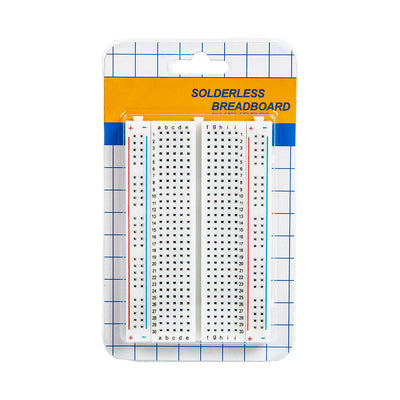
Front view of ShillehTek 830-point solderless breadboard in retail packaging 830 Point Solderless Breadboard for Arduino, Raspberry Pi & ESP32 ★★★★★ (13) $6.99 This item
Total for 4 items
$26.22

Products related to this item

Product Overview

The ShillehTek 830 Point Breadboard is a classic solder-free prototyping board that makes it easy to build and test circuits quickly with Arduino, Raspberry Pi, ESP32, sensors, and modules. With plenty of tie points, you can prototype everything from simple LED circuits to multi-sensor IoT builds without committing to solder. It is ideal for learning electronics, rapid debugging, and building clean test setups before moving to a permanent board.

The board provides a 630 tie-point main grid plus 200 power-rail points on standard 2.54 mm spacing, so DIP ICs, headers, modules, and dev boards drop straight in. Dual power rails on both sides keep 3.3 V and 5 V distribution tidy, spring-metal contacts hold jumper wires firmly through repeated use, and the self-adhesive backing lets you mount it to a project base - or clip multiple boards together side by side for larger circuits.

Frequently asked questions

Yes. This solderless breadboard can be used with Arduino, Raspberry Pi, ESP32, sensors, and modules for temporary circuit prototyping. Use appropriate jumper wires and ensure each connected device is powered within its own safe operating limits.
No soldering is required. Components and jumper wires press into the breadboard’s tie points, making it suitable for quick setup, circuit changes, classroom learning, and testing before building a permanent soldered version.
The breadboard is a passive prototyping accessory and does not set or regulate voltage. It simply connects inserted leads internally, so the voltage and signal compatibility depend on the Arduino, Raspberry Pi, ESP32, sensor, or power source used.
It is useful for building and testing circuits such as LED experiments, sensor hookups, and multi-sensor IoT prototypes. The 830 tie points provide room to arrange modules, jumper wires, and supporting components before committing to a permanent design.
Intermittent connections are often caused by loose jumper wires, component leads that are too thin or damaged, or incorrect row placement. Re-seat the parts, verify the breadboard’s row connections, and check that power and ground are wired correctly.

Have other questions?

Chat with our US-based team — we usually reply fast.

Features & Specs

830 Tie Points Plenty of space for full prototypes, multi-sensor wiring, and larger circuits.

Solder-Free Prototyping Build, test, and iterate quickly without permanent connections.

Microcontroller Friendly Perfect for Arduino, Raspberry Pi, ESP32, and common sensor modules.

Great for Learning + Debugging Ideal for STEM projects, classroom labs, and bench testing hardware.

Reusable Workbench Essential A must-have base tool for nearly every electronics project.

Documents

Full Product Manual ShillehTek 830 Point Breadboard for Arduino, Raspberry Pi, ESP32, and Other Microcontrollers | ShillehTek Product Manual In-depth setup guide with wiring, code examples, and troubleshooting.

Related Tutorials

Raspberry Pi Pico W LoRa: Build a Sender Receiver Link
Dec 08, 2024Tutorial

Raspberry Pi Pico W LoRa: Build a Sender Receiver Link

Build a long-range LoRa sender-receiver link with two Raspberry Pi Pico W boards using AT-command modules for low-pow...
Heltec V3 LoRa + GT-U7 GPS: Send Coordinates via Meshtastic
Apr 07, 2026Tutorial

Heltec V3 LoRa + GT-U7 GPS: Send Coordinates via Meshtastic

Build a Heltec V3 LoRa GPS tracker with a GT-U7 NEO-6M module that sends live coordinates over Meshtastic to a base s...
Breadboard Arduino TP4056: Rechargeable 5V Power
Apr 29, 2026Tutorial

Breadboard Arduino TP4056: Rechargeable 5V Power

Build a rechargeable 5 V breadboard power module using a TP4056 charger, 18650 cell, and boost converter so Arduino p...
Arduino ST7735 TFT: Drive a Color Display via SPI
May 09, 2026Tutorial

Arduino ST7735 TFT: Drive a Color Display via SPI

Build an Arduino ST7735 TFT SPI display project: wire a 1.8-inch 128×160 color screen, install Adafruit libraries, an...
Arduino UNO R4 vs R3 and Leonardo: Pick the right board
May 29, 2026Tutorial

Arduino UNO R4 vs R3 and Leonardo: Pick the right board

Compare Arduino UNO R3, Leonardo, UNO R4 Minima, and UNO R4 WiFi to pick the right board based on USB, I/O, power, an...
BBC micro:bit vs Arduino: Choose the right starter board
May 29, 2026Tutorial

BBC micro:bit vs Arduino: Choose the right starter board

Compare BBC micro:bit V2 vs Arduino UNO/Nano to choose the best education board for beginners, including built-in fea...
Arduino Nano TCA9548A: Run 8 Identical I2C Devices
Jun 10, 2026Tutorial

Arduino Nano TCA9548A: Run 8 Identical I2C Devices

Wire an Arduino Nano to a TCA9548A I2C multiplexer to run up to eight identical 0x3C OLEDs or sensors without address...
Maker Component Cabinet Resistor Kits: Find Parts Fast
Jul 10, 2026Tutorial

Maker Component Cabinet Resistor Kits: Find Parts Fast

Build a labeled drawer component cabinet to organize 1900+ resistors, capacitors, and transistors so you find values ...
Arduino PN532 NFC/RFID: Read, Write, Build Wallet
Jul 29, 2026Tutorial

Arduino PN532 NFC/RFID: Read, Write, Build Wallet

Build an Arduino PN532 NFC/RFID reader-writer with a 1602 LCD, then store packed-BCD credits on a MIFARE tag for an e...
Arduino Uno MCP23017: Add 16 I2C GPIO Pins
Aug 21, 2026Tutorial

Arduino Uno MCP23017: Add 16 I2C GPIO Pins

Build an Arduino Uno MCP23017 I2C GPIO expander that adds 16 extra pins, then scale it into a DIN-rail industrial mod...

Related Videos

Customer Reviews