


Project Overview
DIY 4S 18650 pack with a 4S BMS protection board: build a safer, cheaper, and repairable 14.8 V (16.8 V full) lithium battery pack for DIY power projects using matched 18650 cells and a balance-capable BMS.
This guide covers cell selection, a no-spot-welder assembly approach using nickel strip and solder, and correct 4S BMS wiring. The same concepts scale to 1S, 2S, and 3S packs by swapping the protection board.
- Time: About 30 minutes (plus time to match and rest cells)
- Skill level: Intermediate
- What you will build: A 4S 18650 battery pack with balance charging and protection for over-current, over-discharge, over-temperature, and short-circuit
Parts List
From ShillehTek
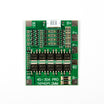
- 4S 30A 18650 Battery Protection Board (14.8V) - the BMS used for this 4S build
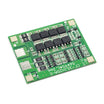
- 3S 25A Balanced Protection Board (12V) - option for 11.1V (3S) packs
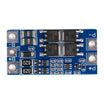
- 2S 10A Balanced Protection Board (7.4V) - option for 2S packs
- 1S 3A Protection Board (3.7V) - option for 1S packs
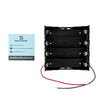
- 4 x 18650 Battery Holder Box - quick way to hold cells in the 4S alternating orientation
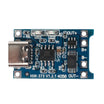
- TP4056 USB-C Charging Board - charger module for 1S packs
External
- Four matched 18650 cells (same brand, same capacity, same current rating, ideally bought at the same time)
- Pure nickel strip (or copper) and high-current solder (60/40 with rosin core)
- Kapton tape, fish-paper insulators, and shrink wrap
- A 16.8 V CC/CV lithium charger (or use the protection-board charge port)
Note: For multi-cell packs, series cells must be closely matched in capacity and internal resistance. Incorrect balance lead order (B-, B1, B2, B3, B+) can destroy the BMS.
Step-by-Step Guide
Step 1 - Select and match your 18650 cells
Goal: Start with four series cells that behave the same under charge and load.
What to do: Only place cells in series if they have similar capacity and internal resistance. Charge all four to 4.20 V, let them rest for 24 hours, then measure each cell’s voltage. They should be within 10 mV of each other. A weak cell will sag faster under load and pull down the whole pack.
For high-current packs (ebike, drone), use quality cells such as Samsung 30Q, Sony VTC6, or Molicel P28A. Random no-name cells are better reserved for low-current builds (LED strip, power bank).

Expected result: Four cells that measure nearly the same voltage after resting, indicating they are suitable to be used in series.
Step 2 - Arrange the cells in a 4S series layout
Goal: Physically position the cells so the series connections are simple and short.
What to do: For a 4S pack, alternate cell orientation +/-/+/- in the holder. This puts the negative of one cell next to the positive of the next so you can bridge each pair with a nickel strip connection.
Code:
Pack(-)  =  Cell1(-)
            Cell1(+) ---|---- Cell2(-)
                          Cell2(+) ---|---- Cell3(-)
                                        Cell3(+) ---|---- Cell4(-)
                                                       Cell4(+) = Pack(+)

Balance taps:
  B-    -> Pack(-)
  B1    -> between Cell1+ and Cell2-
  B2    -> between Cell2+ and Cell3-
  B3    -> between Cell3+ and Cell4-
  B+    -> Pack(+)
Expected result: The pack negative is at Cell1(-), the pack positive is at Cell4(+), and you have clear midpoints for B1, B2, and B3 balance taps.
Step 3 - Wire the 4S 30A BMS correctly
Goal: Connect balance leads and output leads so the BMS can balance-charge and protect the pack.
What to do: The BMS has 6 connection points: B-, B1, B2, B3, B+, plus P- (load output negative). The pack’s positive output is the same as B+. The BMS opens or closes the path between B- and P- to enable or disable the pack.
- Solder the balance taps in order: B-, B1, B2, B3, B+ in increasing voltage order. If you cross any, you can destroy the BMS.
- Charge through the same terminals (the BMS handles balance during charge).
- Connect the load between B+ (pack positive) and P- (BMS-protected negative).
Expected result: The pack can be charged with balancing, and the load sees B+ and P- as the protected output.
Step 4 - Apply insulation and finishing safety measures
Goal: Prevent shorts and make the pack safe to handle and use.
What to do:
- Insulate every positive terminal with a fish-paper washer. A short from + to the can is a fire risk.
- Use Kapton tape on every joint. PVC electrical tape can melt.
- Heat-shrink the whole pack after testing. Avoid exposed conductors.
- Fuse the output. An inline blade fuse is cheaper than a damaged pack.
- Charge with a CC/CV lithium charger, not a random bench PSU.

Expected result: A fully insulated pack with no exposed conductors and reduced short-circuit risk.
Step 5 - Choose the right BMS rating for your application
Goal: Match BMS current capability to your expected peak load.
What to do: The BMS current rating must match your peak load. A 4S 30 A board can handle a 300+ W load (14.8 V x 20 A continuous). For lower draws (Pi cluster, LED panel) the 3S 25 A or 2S 10 A boards are cheaper. For a single-cell power bank, use a 1S 3 A board with a TP4056 USB-C charger.
Expected result: A BMS selection that fits your voltage and current needs without unnecessary cost or overheating risk.
Step 6 - Map the pack to common real-world uses
Goal: Confirm your voltage choice matches the device you want to power.
What to do: Use these examples to sanity-check your design and voltage level:
- Portable Bluetooth speaker: 4S pack + 14 V class-D amp
- Ebike / scooter / kart: 4S in two parallel banks for about 5 Ah at 14.8 V
- FPV drone / RC: 4S packs (often LiPo, not 18650, but similar BMS principles)
- Off-grid LED panel: 3S pack + 12 V LED strip via a buck converter
- Backup UPS for a Pi: 2S pack + boost to 5 V
Expected result: A clear match between pack voltage (1S to 4S) and your end device requirements.
Conclusion
A DIY 4S 18650 lithium battery pack with a properly wired 4S BMS gives you a known set of cells, balanced charging, and built-in protection. Compared to unknown packs bought online, you can choose trusted cells, understand every connection, and replace individual cells later instead of discarding the whole pack.
Want the exact parts used in this build? Grab them from ShillehTek.com. If you want help customizing a battery pack solution or building something for your product, check out our IoT consulting services.
Credit: This guide was inspired by "DIY 4S Lithium Battery Pack With BMS" on Instructables. Images credited to the original author.



.png?v=25000753014097803521791168436)

.png?v=68677308723310773341791168436)


