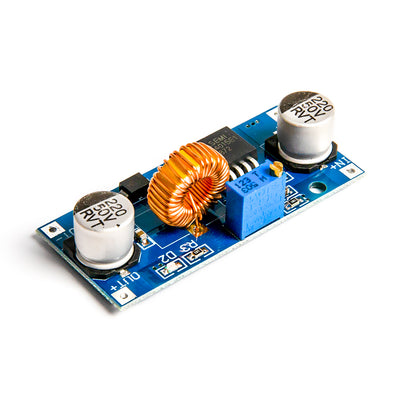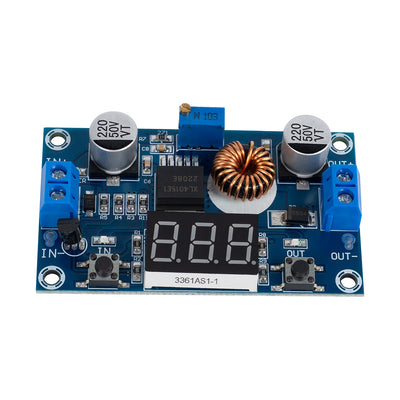
LM2596 Step-Down Buck Converter Module: DC-DC w/ Digital Voltmeter
Couldn't load pickup availability

- [ADJUSTABLE OUTPUT] Easily steps down voltage from 4.0V-40V to 1.25V-37V with precise control for a variety of electronics projects.
- [DIGITAL VOLTMETER DISPLAY] Built-in LED screen shows real-time input or output voltage, making monitoring easy and efficient.
- [HIGH-EFFICIENCY PERFORMANCE] LM2596 chip delivers up to 92% efficiency with excellent heat dissipation and stable output.
- [WIDE APPLICATIONS] Ideal for Arduino, Raspberry Pi, battery chargers, LED strips, robotics, and DIY electronics projects.
- [BUILT-IN SAFETY FEATURES] Equipped with thermal shutdown and short-circuit protection to ensure safe and reliable operation.
No additional feature info available.
No documents available. Please contact us for more information.
This adjustable buck converter from Shillehtek works great. It has a display onboard that can be toggled between showing the input voltage or the output voltage by pressing a button. I wish the precision would be at least one more decimal place, but I put my multimeter on it to dial it in more accurately.Overall, if you need to adjust input voltage for your projects, this one is worth checking out.
I wanted to create my own variable power supply and this works perfect for my needs! I am very impressed with the build of the unit and interface (dials and display are very nice) and work perfect for my needs. As another poster mentioned, I wouldn't push this unit past about 30v even though it's probably possible to get 35v out of it, I wouldn't.For the price, this is a steal for my needs. I have specific requirements for my power supply and am very happy that I stumbled upon this one!
I used this buck convertor to power a Raspberry Pi for a 3D Printer project, taking 24V from the power supply and regulating it down to 5V for the single board computer. As others have mentioned, better to keep the output voltage below 30V due to ratings of some components on the board. I have it in the air stream of a fan, so I'm not too worried about heating up even if the computer draws 10-12W or so, but you'll want to check the heat generation in your specific setup. Forgot to snap a pic of it before it was all wired up, but it's working in there and haven't had any problems with stability of the power for the Pi.
It does the job very well! I used it with a 100W 5V power supply and was able to provide from 1.25V to 37V output with roughly 90% efficiency. This allows me to select the output voltage inversely supplying the current proportionally to the voltage rise.I used it to supply 24V to a digital amplifier board that works best at 24V rather than 12V and won't start at all at 5V.It works veyr well, it has 4 standoff holes that can be used to panel-mount this board. I will soon incorporate this into the project but won't be displaying the DC-DC power supply controls. This is one of those great little devices that works way better than the $8 might suggest! It's an amazing value!
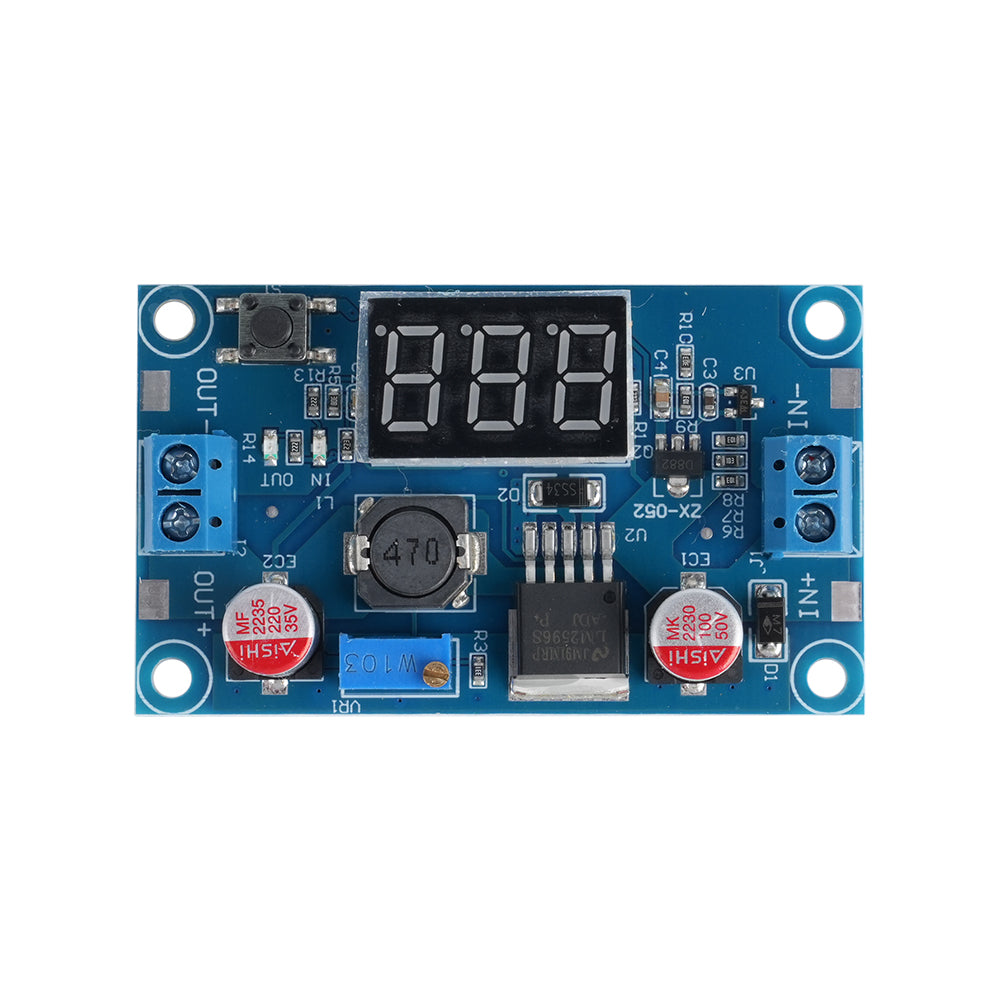
There are many small, inexpensive power supply modules available that utilize versions of the LM2596 step-down switching regulator integrated circuit. This particular one has a built-in three-digit digital voltmeter that can display the input voltage or the output voltage, selectable by pressing the little push-button switch near the corner of the board. (Successive presses toggle between input and output voltage; nearby red LEDs labeled "IN" and "OUT" indicate which one is being measured. Holding the switch down for a second or so turns the display off--until the next press.) The voltmeter was surprisingly accurate, when compared to my trusty digital mutimeter.The circuit provides very good line and load regulation. It will shut down automatically if its thermal limit is exceeded, and it also has short-circuit protection. It is specified as operating with input voltages from 4.0 to 40 volts, and its output voltage can be adjusted from 1.25 to 37 volts by using the blue multi-turn trimmer near one edge of the board.Although the output voltage can theoretically be set as high as 37 volts, note that the filter capacitor on the output is rated for a maximum of just 35 volts. While it can probably withstand a little more, it is not advisable to exceed a component's marked maximum voltage. And while this device is rated for up to 3 Amps continuous output current, it would not be advisable to use it at that level without providing additional cooling. Also, at high current levels, electrical noise on the output increases to levels that may interfere with sensitive circuitry--although that may not be a concern in a non-critical application such as a battery charger or an LED driver.Note that this is a step-down voltage converter only--it cannot be used to provide an output voltage that is as high as--or higher than--the input voltage connected to it. Also, no instructions are provided with it--but the information shown above should be sufficient to make use of its capabilities.
I use these LM2596 DC-DC Adjustable Step-Down Power Supply Modules to provide power to Arduino and Raspberry Pi Pico projects that I build. I have numerous 12-volt power supplies, but most microcontrollers require either 3.3-volts or 5-volts. These step-down modules provide clean power and the output is reasonably stable as the load changes. The digital voltmeter seems accurate and can be used to monitor and adjust the output voltage if the input voltage or load changes significantly. I like the screw terminals and the solder pads; the screw terminals are great for testing while the soldered terminals are great for permanent installations. I highly recommend these.
This is a great buck converter that can reduce 4-40V to 1.25-37V. . . theoretically. The flaw is that the output capacitor is only rated for 35V, so I wouldn’t try to get more than about 30V out of this, so you don’t risk stressing that output cap and blowing it. I’m knocking off just one star for this, since it’s an edge case for most people using a buck converter. I’m using it to reduce 24V to 5V, so not an issue for me. The thing that is an issue is the display always reads about 0.1 volt too low, whether it’s displaying input or output. I’ll forgive that, and keep the rating at 4 stars.
I'm not going to dock any stars for the lack of precision because it probably doesn't matter for most cases, but I would definitely prefer to have another decimal place. It does work great though. The output voltage stays steady, even when the input voltage changes. It's definitely good enough to power my microcontrollers from various LiPo batteries. Also, the ability to toggle between input and output voltage readouts is nice.It seems solidly made, and the price is decent for what you get. There may be cheaper on this site, but they may also be poorly made and less accurate, so beware of that.