Skip to product information
1 of 1

ShillehTek MQ-135 Air Quality Hazardous Gas Sensor Module for Arduino

ShillehTek MQ-135 Air Quality Hazardous Gas Sensor Module for Arduino

Regular price $6.00 USD
Regular price Sale price $6.00 USD
Sale Sold out
Tax included. Shipping calculated at checkout.

MQ-135 Air Quality gas sensor module for Arduino detects NH3, NOx, CO2 and VOCs to monitor indoor pollution; analog and digital outputs ideal for logging air quality or triggering ventilation.

View full details

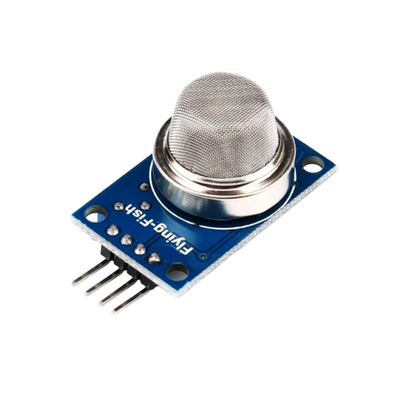
The MQ-135 Air Quality Hazardous Gas Sensor Module for Arduino uses a sensitive Tin Dioxide (SnO2) sensing layer that changes conductivity when exposed to polluted air, letting you monitor common indoor pollutants such as ammonia (NH3), nitrogen oxides (NOx), alcohol, benzene, smoke and CO2. The board provides both a linear analog output for logging concentration trends and a digital output driven by an onboard LM393 comparator for simple alarm thresholds, and it mounts on a standard 4‑pin header (VCC, GND, DO, AO) that fits breadboards and Arduino shields. It can be calibrated against clean‑air Ro values to estimate PPM and includes an active heater that needs an initial 24‑hour burn‑in to stabilize readings—practical for makers building monitors or ventilation controls.

No additional feature info available.

No documents available. Please contact us for more information.

Product Overview

The MQ-135 Air Quality Hazardous Gas Sensor Module for Arduino uses a sensitive Tin Dioxide (SnO2) sensing layer that changes conductivity when exposed to polluted air, letting you monitor common indoor pollutants such as ammonia (NH3), nitrogen oxides (NOx), alcohol, benzene, smoke and CO2. The board provides both a linear analog output for logging concentration trends and a digital output driven by an onboard LM393 comparator for simple alarm thresholds, and it mounts on a standard 4‑pin header (VCC, GND, DO, AO) that fits breadboards and Arduino shields. It can be calibrated against clean‑air Ro values to estimate PPM and includes an active heater that needs an initial 24‑hour burn‑in to stabilize readings—practical for makers building monitors or ventilation controls.

Product Overview

The MQ-135 Air Quality Hazardous Gas Sensor Module for Arduino uses a sensitive Tin Dioxide (SnO2) sensing layer that changes conductivity when exposed to polluted air, letting you monitor common indoor pollutants such as ammonia (NH3), nitrogen oxides (NOx), alcohol, benzene, smoke and CO2. The board provides both a linear analog output for logging concentration trends and a digital output driven by an onboard LM393 comparator for simple alarm thresholds, and it mounts on a standard 4‑pin header (VCC, GND, DO, AO) that fits breadboards and Arduino shields. It can be calibrated against clean‑air Ro values to estimate PPM and includes an active heater that needs an initial 24‑hour burn‑in to stabilize readings—practical for makers building monitors or ventilation controls.

Features & Specs

[Gas detection types]: Detects common pollutants including NH3, NOx, alcohol, benzene, smoke and CO2.

[Sensor technology]: Uses a Tin Dioxide (SnO2) sensing layer that changes conductivity in polluted air.

[Analog and digital]: Provides a linear analog output for concentration logging and a digital output via LM393 for alarm triggers.

[Heater burn-in required]: Requires a 24-hour initial burn-in to stabilize the internal heater and improve accuracy.

[Calibration capable]: Can be calibrated against known clean-air Ro values for more precise PPM measurements.

[Compact interface]: Ships with a standard 4-pin header (VCC, GND, DO, AO) for breadboard and shield mounting.

[DIY application use]: Ideal for Arduino-based pollution monitors and automated ventilation control projects.

Features & Specs

[Gas detection types]: Detects common pollutants including NH3, NOx, alcohol, benzene, smoke and CO2.

[Sensor technology]: Uses a Tin Dioxide (SnO2) sensing layer that changes conductivity in polluted air.

[Analog and digital]: Provides a linear analog output for concentration logging and a digital output via LM393 for alarm triggers.

[Heater burn-in required]: Requires a 24-hour initial burn-in to stabilize the internal heater and improve accuracy.

[Calibration capable]: Can be calibrated against known clean-air Ro values for more precise PPM measurements.

[Compact interface]: Ships with a standard 4-pin header (VCC, GND, DO, AO) for breadboard and shield mounting.

[DIY application use]: Ideal for Arduino-based pollution monitors and automated ventilation control projects.

Documents

Documents

Related Videos

Related Videos

Customer Reviews

Be the first to write a review
0%
(0)
0%
(0)
0%
(0)
0%
(0)
0%
(0)

Customer Reviews

Be the first to write a review
0%
(0)
0%
(0)
0%
(0)
0%
(0)
0%
(0)