Overview
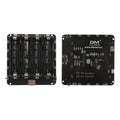
The 2x18650 battery shield V8 is a compact battery power module: drop in two rechargeable 18650 cells and it serves regulated 5V (up to ~3A peak) from a USB-A port and header pads, plus a 3V rail for low-voltage loads. Charging, cell protection, and indicator LEDs are built in — it is the fastest way to make an ESP32, Arduino, or Pico project truly portable.
The two cells ride in parallel, doubling capacity (two 3,000 mAh cells act as one 6,000 mAh pack) while keeping the shield slim enough to velcro under a robot chassis or inside a project box. Nothing to wire: insert cells, charge over USB, plug your board into the USB-A output.
At a Glance
Cells
2x 18650 (parallel)
Protection
Over-charge/discharge
Ports
USB-A out + pin headers
Specifications
| Parameter |
Value |
| Battery Slots |
2x 18650 Li-ion, parallel (1S2P) |
| 5V Output |
Rated ~2.2A continuous, ~3A peak (USB-A port + 5V header pads) |
| 3V Output |
3V / 1A on header pads |
| Charge Input |
USB (micro-USB or Type-C depending on batch), ~600-800 mA |
| Protection |
Over-charge, over-discharge, over-current (built-in IC) |
| Indicators |
Charge / power status LEDs |
| Cell Fit |
Standard 65 mm cells; long protected cells may not fit |
| Use While Charging |
Light pass-through supported |
| Form Factor |
Slim two-slot shield with mounting holes |
Setup & Power Guide
1. Insert two matched cells
Align each cell's + end with the + mark in the holder. The slots are parallel — a reversed cell shorts against its neighbor and damages the board immediately. Use two cells of the same model and age at similar charge levels.
2. Charge over USB
Any 5V USB adapter works. Expect several hours for a full charge of two high-capacity cells at the shield's ~0.7A charge rate; the LEDs show charging vs done.
3. Connect your project
| Load |
Connect Via |
| Dev board with USB (ESP32, Arduino, Pico) |
USB-A port with a short cable — the plug-and-play option |
| Bare 5V input (VIN/5V pin) |
5V + GND header pads |
| 3V-class loads |
3V + GND header pads |
Warning: Only quality, matched 18650s — mixing a fresh cell with a tired one makes them fight each other in parallel, cutting life and capacity. Avoid unknown-history laptop pulls, and never install a visibly damaged or bulging cell.
Note: If you power a dev board through its 5V/VIN pin from the header pads, avoid also plugging that board's USB into a PC at the same time unless you've confirmed its power-OR design — or just keep things simple and use the shield's USB-A port.
Tip: Runtime estimate: pack Wh x 0.85 / project watts. Two 3,000 mAh cells ≈ 22 Wh x 0.85 ≈ 19 Wh — an ESP32 sensor node averaging 0.5 W runs about a day and a half; add deep sleep and it stretches to weeks.
Frequently Asked Questions
Will it run with just one cell?
Yes — parallel slots mean one cell works fine at half the capacity. Two matched cells simply double runtime and handle current spikes with less voltage sag.
Is 5V/3A continuous realistic?
Plan around ~2.2A continuous with 3A as short-peak headroom. Two healthy high-drain cells handle ESP32 Wi-Fi bursts easily; a Raspberry Pi 4 under sustained load is asking too much of this class of shield.
Can I charge and power my project at the same time?
For light loads, yes — basic pass-through works. But the ~0.7A charge input is shared, so heavy loads stall charging, and switchover isn't UPS-grade seamless. Critical always-on builds deserve a dedicated UPS board.
Why won't my protected 18650s fit?
Protection circuits add ~4 mm of length, and these holders are sized for standard 65 mm cells. Use unprotected flat-tops — the shield's own protection IC covers over-charge and over-discharge duty.
The output died suddenly — is the shield broken?
More likely the under-voltage protection tripped on empty cells (cutoff ~2.5-3V per cell). Recharge and output returns. If it recurs quickly, one cell is worn out and dragging the pack down — test cells individually.
2-slot or 4-slot shield — which should I get?
Same electronics, different capacity and footprint. Pick the 2-slot for slim robots, handhelds, and short missions; the 4-slot for long-running loggers, camera rigs, and anything you'd rather charge weekly than daily.
Related Tutorials