8-Channel 24V Relay Module for Arduino Raspberry Pi Control
Couldn't load pickup availability

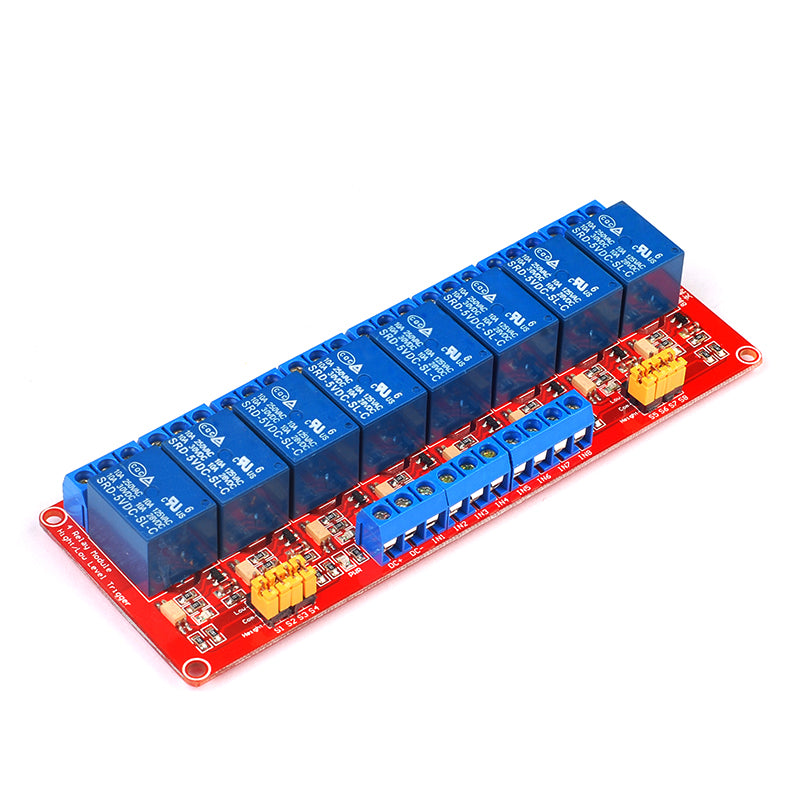
- [8 RELAY CHANNELS]: Controls up to 8 devices simultaneously with a robust 24V relay board designed for industrial and home automation.
- [HIGH & LOW LEVEL TRIGGER]: Supports both triggering modes for flexible integration with Arduino, Raspberry Pi, PLCs, and other controllers.
- [24V COMPATIBLE]: Operates at 24V input, making it ideal for industrial-grade systems, motors, lighting, and automation projects.
- [SAFE & RELIABLE DESIGN]: Features optocoupler isolation and status LEDs on each channel for stable and secure operation.
- [WIDE APPLICATION]: Perfect for home automation, smart devices, industrial controls, robotics, and IoT projects.
No additional feature info available.
No documents available. Please contact us for more information.
Simple easy to use device. All the relays worked. Not much more you can ask for.
Seems to have advanced stealth technology. (Not really, but it's amusing, but which will not play into my review.)These are 12V relays which means that you need to supply 12V to them. I tested with lower input voltage and it did not work. The relays can either trigger high (Height on the board) or low. It comes with 8 jumpers, which were on my board set to high trigger.The isolation seems pretty decent. With the optoisolators, and the board design, (There's a cutout around the common of each relay, I think it should be fairly safe as setup, as long as you don't like put it in a metal box and allow contact. I would say both AC and DC should be good.)There's one hangup that's purely aesthetic, which is that 7 of the 8 are in a nice line, and setup well. However, the 8th is high on one side. Argh!Tested all of the relays and they all work. The PCB seems decently made though the LEDs seem a bit off and there's that one relay. (If it annoys me tomorrow, I may just hit it with the hot air gun and deal with it.)The relays are Songle SRD-12VDC-SL-C, 10 A AC (@125/250VAC) or DC (@28V/30V DC) (Not sure why they marked the lower voltages on them, as it's the current that matters below the max switched voltage. So if you weren't aware, that's 10A @ 0VAC-250VAC, or 0VDC-30VDC)My plan is to use this to control some 12V automotive systems so it should be good for that. Haven't decided on a pi or something else (esp/arduino), but either will be able to use this.Overall, despite the aesthetic issue, I give it 5/5 as everything seems good. If that changes I'll update the review.-----Story time. This thing somehow has some advanced optical camo, because unless it's in my hands it basically ceases to exist. First time I lost it, it was right under/behind a camera and I just couldn't see it. Then I dropped it into a box, several subsequent times I've put it next to testing stuff it's just blended in. I can't explain it, it should be visible easily with the blue relays and red pcb. It somehow just vanishes. You can be looking at it, and won't see it! Somehow this is leaked Martian stealth composites, err wrong universe. Like 6 times today! But somehow, despite that, I'll never unsee the uneven relay!
I've tried several Shillehtek products and been happy with them. This relay package is no exception. The board is sturdy, and well labeled. There is one typo where high is spelled heigh, but that happens in translation sometimes. I powered up the board and was able to trigger the relays as expected. You can use high or low triggering and that is set by individual jumpers for each relay. I'm happy with this device.
I ordered the "8-Channel 5V Relay Module – High & Low Level Trigger Relay Controller Board" but got the 4-channel relay instead so I am doing the review on the 4 channel relay. This module is necessary when interfacing/controlling different pieces of equipment that are powered with a different voltage. The circuit board is clearly marked for both input and outputs and how to change the trigger from a low level to a high level. There is a pwr light that shows power is connected to the board and has 4 mounting holes that facilitate mounting the board on a stable item.It does its job and seems to be quality made.
Board is a little rough, edges fraying fiberglass, lots of flux left on the board underneath (see photo), and occasional mis-translations on the silkscreen (example: "high" logic level labeled as "height"). The requirement for 12v isn't great for a lot of projects as you'll need a second supply but might be helpful for something like automotive use maybe? Tested all channels with a 3.3v signal and everything works like I'd expect. Each channel has a TWS354 isolator which is a nice touch.