Overview
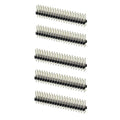
This 10-pack of 1x40 right-angle male pin headers is a workshop staple for any project where a straight-up header would get in the way. The 90° bend lets you route connections parallel to your PCB surface — perfect for enclosure-friendly builds, low-profile shields, and side-exit wiring on breakout boards.
Each strip has 40 pins on a standard 2.54mm (0.1") pitch, the same spacing used on Arduino, Raspberry Pi, ESP32, and nearly every through-hole prototyping board. The strips snap cleanly between any two pins, so you can break off exactly the length you need — no sawing, no filing.
At a Glance
Orientation
Right Angle (90°)
Specifications
| Parameter |
Value |
| Pin Pitch |
2.54mm (0.1") |
| Pin Count Per Strip |
40 pins |
| Strip Orientation |
Right angle, single row |
| Mating Length (horizontal pin) |
~6mm |
| Solder Tail Length |
~3mm |
| Insulator Material |
PBT plastic, black |
| Pin Material |
Brass, nickel plated |
| Current Rating |
3A per pin |
| Voltage Rating |
250V AC/DC |
| Operating Temperature |
-40°C to +105°C |
How to Use
Count the pins you need, then break the strip by bending firmly against a table edge or with small pliers. The break is clean — no filing required — but if you want a perfectly flush edge, a quick pass with a file or sanding block smooths it out.
Drop the header into your PCB with the bent tail facing down and the horizontal pins pointing outward. Tack a corner pin from the top to hold it in place, check the alignment, then solder the remaining pins from the underside.
Tip: Right-angle headers are ideal when you plug wires or ribbon cables into the side of a board rather than the top — great for slim enclosures and modules that sit flush inside a case.
Good to know: These mate with standard 2.54mm female headers, Dupont jumper wires, breadboards, and ribbon cable IDC connectors.
Frequently Asked Questions
How do I split a 40-pin strip into smaller sections?
Hold the strip at the gap between two pins and bend it sharply against a hard edge. It snaps cleanly. For very small sections (1-2 pins), use small pliers for more control.
Can I use these with Dupont jumper wires?
Yes. Female-to-female or female-to-male Dupont wires plug directly onto these pins. The 2.54mm pitch is the standard across Arduino, Raspberry Pi, ESP32, breadboards, and most hobby electronics.
When should I pick right-angle over straight headers?
Choose right-angle when you want wires to exit parallel to the PCB — useful for enclosures, low-profile designs, and boards that need side-exit connections. Choose straight headers when you're plugging into breadboards or stackable shields.
How much current can each pin carry?
Each pin is rated for 3A continuous. For higher current (motors, heaters, high-current LED strips), use screw terminals or dedicated power connectors instead of pin headers.
Do these work with breadboards?
Yes, but the right-angle shape means one row of pins sits flat against the board surface instead of sticking down into the breadboard. For breadboard prototyping, straight headers are usually easier to work with.
What soldering iron temperature should I use?
320-360°C (600-680°F) with lead-free solder, or 300-340°C (570-640°F) with leaded solder. The black plastic insulator tolerates normal soldering heat, but don't linger on a single pin more than 3-5 seconds.
Related Tutorials