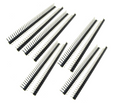
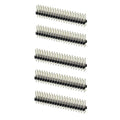
Overview
This 20-pack of 1x40 female pin headers (sometimes called female sockets or header receptacles) is the matching half to any 2.54mm male pin header. They turn fixed pins into sockets — which means swappable modules, stackable shields, and clean, repairable builds.
Each strip gives you 40 positions on a 2.54mm (0.1") pitch. Common uses include sockets for Arduino-style dev boards, Raspberry Pi HATs, ESP32 modules, and sensor breakouts you want to unplug without de-soldering. Cut to the exact length you need with a sharp knife or diagonal cutters.
At a Glance
Profile
Straight, Single Row
Specifications
| Parameter |
Value |
| Pin Pitch |
2.54mm (0.1") |
| Pin Count Per Strip |
40 positions |
| Configuration |
Single row, straight |
| Socket Depth |
~6mm |
| Solder Tail Length |
~3mm |
| Total Height |
~8.5mm |
| Insulator Material |
PBT plastic, black |
| Contact Material |
Phosphor bronze, tin plated |
| Mating Pin Diameter |
0.40mm - 0.64mm square |
| Current Rating |
3A per contact |
| Voltage Rating |
250V AC/DC |
| Operating Temperature |
-40°C to +105°C |
How to Use
Unlike male pin headers, female headers don't snap cleanly between positions — the plastic shell is one continuous piece. To shorten a strip, use a sharp hobby knife or small diagonal cutters to cut through the plastic between two sockets. Expect to lose one socket in the cut; trim the edges smooth with a file.
Drop the header into your PCB's through-holes, tack a corner pin to lock alignment, then solder each tail from the underside. Because female headers are taller than the board, you can use gravity (flip the board upside-down on a flat surface) to hold them flush while soldering.
Tip: To socket a sensor breakout on your PCB, solder this female header to the PCB, then solder a matching 1x40 male header to the breakout module. The module plugs in and out — perfect for swapping sensors or reusing modules in new projects.
Heads up: When cutting a strip to length, you will lose one position (the one you cut through). Plan your cuts so you have one sacrificial position at the break point.
Mates with: 2.54mm male pin headers (straight, right-angle, or breakaway), Dupont male-tipped wires, and square 0.64mm leads.
Frequently Asked Questions
How do I cut a 40-position strip to the length I need?
Use a sharp hobby knife or diagonal cutters to cut through the plastic between two sockets. You'll lose the one position you cut through — so if you need 8 usable sockets, cut between positions 8 and 9. File the rough edge smooth afterwards.
Will these mate with all 2.54mm male pin headers?
Yes. They accept standard 2.54mm pitch male headers with 0.40-0.64mm square pins — which is nearly every hobby-grade male header, Dupont connector, and breakout-board pin on the market.
Can I use these to socket an Arduino-style module on my PCB?
Yes, that's one of their most common uses. Solder female headers to your PCB where the module's pins will land, solder male headers to the module, and you can unplug and swap modules without de-soldering. Great for ESP32 DevKits, Pico, Nano, and sensor breakouts.
Can they be used as stacking headers?
No — these are flat-bottom sockets only. True stacking headers have long male pins extending below the plastic, so they plug into a board and accept something on top. For stacking Arduino shields or Pi HATs, you need dedicated stacking headers.
What's the socket depth?
About 6mm, which accommodates the standard 6mm mating length on nearly every 2.54mm male header. Longer pins still fit — they just bottom out in the socket and project through the underside of the header.
Do I need anti-static precautions when handling these?
The headers themselves are not ESD-sensitive — they're just plastic and metal. But the devices you'll plug into them (microcontrollers, sensors) can be. Standard ESD precautions apply when handling those modules, not the headers.
Related Tutorials