Documentation

TP4056 1A 3.7-4.2V LiPo Battery Charging Board with Micro USB & Current Protection | ShillehTek Product Manual
Documentation / TP4056 1A 3.7-4.2V LiPo Battery Charging Board with Micro USB & Current Protection | ShillehTek Product Manual

TP4056 1A 3.7-4.2V LiPo Battery Charging Board with Micro USB & Current Protection | ShillehTek Product Manual

Overview

The TP4056 module is the most-used small lithium-ion / LiPo battery charger on the maker market. Plug a 3.7V LiPo or 18650 cell into the B+/B- terminals, connect a 5V supply (USB phone charger, USB-A from a computer) to the IN+/IN- terminals or the onboard Micro USB port, and the TP4056 IC handles the entire constant-current / constant-voltage charging cycle automatically. Two LEDs indicate charging in progress (red) and full charge (green / blue).

This particular variant adds a current protection IC (DW01 + dual MOSFET) on the OUT+/OUT- side that protects the cell from over-discharge, over-charge, and short-circuit conditions — load-side protection that's essential for safe LiPo usage. Use OUT+/OUT- to power your project; never connect a load directly to B+/B- without protection.

Charging current is set by R3 (default ~1A with the supplied 1.2 kΩ resistor; can be lowered for smaller cells by changing the resistor). Use it to power-bank a Pi Zero, run an ESP32 sensor node from a battery, build a portable speaker, or any project where 3.7V Li-ion convenience and recharging are needed.

At a Glance

Charge IC
TP4056 (linear CC/CV charger)
Protection IC
DW01 + 8205A dual MOSFET
Input
Micro USB (5V) or IN+/IN-
Charge Current
1A (default), 130 mA - 1A range
Cell Voltage
3.7V Li-ion / LiPo (charges to 4.2V)
Protection
OV / UV / over-current / short

Specifications

Parameter Value
Charge IC TP4056
Protection IC DW01A + 8205A dual N-channel MOSFET
Input Voltage 4.5V - 5.5V (USB nominal 5V)
Input Connector Micro USB + screw / solder pads (IN+/IN-)
Output Voltage 2.5V - 4.2V (battery direct, with protection)
Charge Current 1A typical (set by R3 = 1.2 kΩ); range 130 mA - 1 A
Charge Method Linear CC then CV with auto-recharge
Charge Voltage Cutoff 4.2V ± 1%
Discharge Cutoff ~2.4V (DW01 detection)
Over-Current Cutoff ~3 A
Status Indicators Red = charging; Green/Blue = full
Operating Temperature -10°C to +85°C
Dimensions ~28 × 17 mm

Pinout Diagram

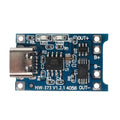
TP4056 1A LiPo battery charging board with Micro USB pinout showing IN+ and IN- power input pads, B+ and B- battery terminals, OUT+ and OUT- protected output pads, charging indicator LED, full charge indicator LED, and the charge-current setting resistor

Pad Descriptions

Pad Function
Micro USB / IN+ / IN- 5V input from USB or wall adapter
B+ / B- Battery positive and negative (connect cell here)
OUT+ / OUT- Protected battery output (connect load here)
R3 (1.2 kΩ) Charge current setting resistor

Wiring Guide

Critical: Always connect the load to OUT+/OUT-, never to B+/B- directly. The DW01 protection circuit is on the OUT side — using B+/B- bypasses protection and can let the battery over-discharge / over-current, damaging the cell or causing fire.
Connection Wire To
Battery + lead B+
Battery − lead B-
Load + (e.g., ESP32 VIN) OUT+
Load − (load GND) OUT-
5V charger / USB Micro USB or IN+ / IN-

Adjusting Charge Current

The charge current is set by R3 (the SMD resistor labeled "122" = 1.2 kΩ on the default board). To use a smaller cell that shouldn't be charged at 1A, replace R3:

R3 Value Charge Current Best For
10 kΩ 130 mA Small 130-300 mAh cells
5 kΩ 250 mA 500-1000 mAh cells
2 kΩ 580 mA 1200-2500 mAh cells
1.2 kΩ (default) 1 A 2500+ mAh cells (e.g., 18650)
Rule of thumb: Charge a cell at no more than 1C (1× its capacity in amps). A 500 mAh cell → max 500 mA charge current. Charging faster reduces battery lifespan and risks damage.

Frequently Asked Questions

My LED stays red forever and never turns green.
The TP4056 only declares "full" when the charge tapers to ~10% of the set rate. With a fully discharged cell that takes hours; if your cell capacity is much lower than the set charge current, it should still finish but check that B+ and B- are not swapped, and that the cell isn't damaged (open-circuit cells will charge forever).
Why does the board get warm during charging?
The TP4056 is a linear charger — it dumps the (5V - Vcell) × Icharge as heat. At 1A and a discharged cell, that's about 2W of heat — the chip's plastic package gets warm to hot. This is normal. If it's too hot to touch, reduce the charge current via R3.
Can I charge multiple cells in series with this?
No — this is a single-cell charger only (3.7V nominal). For 7.4V (2-series) or higher, use a multi-cell battery management system (BMS) like the 2S/3S/4S balance-charge boards.
Can I leave the cell connected to charge indefinitely?
Yes — the TP4056 detects full charge and stops, only resuming if voltage drops below 3.95V. This is the right way to use a "always-on" charger like a power bank.
Can I use it without a battery (just USB pass-through)?
Yes, but the load voltage will be ~4.2V at low load and may drop / vary with current. Better to add a small Li-ion cell in parallel to act as a buffer; the TP4056 will keep the cell topped up and the cell smooths the load voltage.
My output voltage drops to 0V when I draw current.
This is the DW01 protection cutting off due to over-current or under-voltage. Reconnect the cell briefly to USB (charge mode resets the protection). Reduce your load current, or replace the cell if it's been deep-discharged repeatedly.