Overview
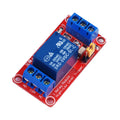
The ShillehTek 1-Channel 24V Relay Module lets an Arduino, Raspberry Pi, ESP32, or Raspberry Pi Pico switch a single high-voltage or high-current load with a low-voltage logic signal — while running the relay coil itself from a 24V supply. The 24V coil is a natural fit for industrial control panels, PLC-style automation, solar charge gear, and equipment that already has a 24V rail available.
The on-board SRD-24VDC-SL-C relay can switch up to 10A at 250VAC or 10A at 30VDC. It is opto-coupled and uses an active-LOW input — pull the IN pin LOW to energize the coil. A red LED indicates relay state and a green LED indicates power. Three screw terminals (NO, COM, NC) provide both Normally Open and Normally Closed switching options.
Because the coil needs 24V, this module requires an external 24V supply for VCC — your microcontroller's 5V rail cannot power it. The IN pin is still driven by 3.3V or 5V logic, just like the lower-voltage variants.
At a Glance
Specifications
| Parameter | Value |
| Coil / Module Voltage | 24V DC |
| Trigger Current | ~15-25 mA per channel (at 24V) |
| Trigger Logic | Active LOW (LOW = relay ON) |
| Trigger Voltage Range | 0V (ON) / 3.3V-5V (OFF) |
| Max Switching Voltage | 250V AC / 30V DC |
| Max Switching Current | 10 A |
| Relay Part | SONGLE SRD-24VDC-SL-C |
| Output Configuration | SPDT (NO / COM / NC) |
| Indicator LEDs | Power (green), Relay state (red) |
| Mounting | 2 screw holes |
| Dimensions (approx.) | 50 x 26 x 18 mm |
Pinout Diagram

Wiring Guide
Arduino Wiring
The 24V relay module needs an external 24V power supply for the coil — do not power VCC from the Arduino. Connect the supply's 24V to VCC, the supply's GND to the module's GND and to Arduino GND (shared ground is required), and drive IN from any digital pin.
| Module Pin | Connect To | Details |
|---|---|---|
| VCC | External 24V supply (+) | NOT Arduino 5V or VIN |
| GND | Supply (-) + Arduino GND | Shared ground required |
| IN | Arduino Digital Pin 7 | Active LOW |
Load wiring (typical, switch high-side of a load):
| Screw Terminal | Connect To |
|---|---|
| COM | One leg of the load circuit |
| NO | Other leg returning to source |
| NC | Leave unused (or wire your "default ON" load) |
digitalWrite(relayPin, LOW) energizes the relay; HIGH releases it. Initialize the pin HIGH in setup() so the relay does not click ON during boot.
ESP32 Wiring
The ESP32 uses 3.3V GPIO, which is enough to drive the IN pin's opto-isolator. The 24V coil supply must come from an external source. Tie all grounds together — ESP32 GND, 24V supply GND, and module GND.
| Module Pin | Connect To | Details |
|---|---|---|
| VCC | External 24V supply (+) | NOT ESP32 VIN |
| GND | Supply (-) + ESP32 GND | Shared ground required |
| IN | GPIO 23 | 3.3V drives opto reliably |
Raspberry Pi Wiring
The Pi cannot supply 24V — use an external 24V power source for the coil. Drive IN from any 3.3V GPIO and tie the Pi's GND, the 24V supply's GND, and the module's GND together.
| Module Pin | Connect To | Details |
|---|---|---|
| VCC | External 24V supply (+) | NOT Pi 5V |
| GND | Supply (-) + Pi Pin 6 (GND) | Shared ground required |
| IN | Pin 16 (GPIO 23) | 3.3V active LOW |
Raspberry Pi Pico Wiring
The Pico cannot source 24V — use an external 24V supply for the coil and drive IN from any GPIO. The Pico's 3.3V logic level is enough to switch the opto-isolator.
| Module Pin | Connect To | Details |
|---|---|---|
| VCC | External 24V supply (+) | NOT Pico VBUS or 3V3 |
| GND | Supply (-) + Pico GND | Shared ground required |
| IN | GP15 | Active LOW |
Code Examples
Arduino
// 1-Channel 24V Relay Module - Arduino Example
// IN pin: Digital 7 (active LOW - LOW closes the relay)
// VCC powered from external 24V supply, GND shared with Arduino

const int RELAY_PIN = 7;

void setup() {
  // Set HIGH first so the relay does not click ON at boot
  digitalWrite(RELAY_PIN, HIGH);
  pinMode(RELAY_PIN, OUTPUT);
  Serial.begin(9600);
  Serial.println("24V relay ready");
}

void loop() {
  Serial.println("Relay ON");
  digitalWrite(RELAY_PIN, LOW);   // active LOW
  delay(2000);

  Serial.println("Relay OFF");
  digitalWrite(RELAY_PIN, HIGH);
  delay(2000);
}
ESP32 (Arduino IDE)
// 1-Channel 24V Relay Module - ESP32 Example
// IN pin: GPIO 23 (active LOW)
// VCC powered from external 24V supply, GND shared with ESP32

const int RELAY_PIN = 23;

void setup() {
  digitalWrite(RELAY_PIN, HIGH); // keep relay off through boot
  pinMode(RELAY_PIN, OUTPUT);
  Serial.begin(115200);
}

void loop() {
  Serial.println("ON");
  digitalWrite(RELAY_PIN, LOW);
  delay(2000);

  Serial.println("OFF");
  digitalWrite(RELAY_PIN, HIGH);
  delay(2000);
}
Raspberry Pi (Python)
#!/usr/bin/env python3
# 1-Channel 24V Relay Module - Raspberry Pi Example
# IN pin: GPIO 23 (active LOW)
# VCC powered from external 24V supply, GND shared with Pi

import RPi.GPIO as GPIO
import time

RELAY_PIN = 23

GPIO.setmode(GPIO.BCM)
GPIO.setup(RELAY_PIN, GPIO.OUT, initial=GPIO.HIGH)  # start OFF

try:
    while True:
        print("Relay ON")
        GPIO.output(RELAY_PIN, GPIO.LOW)   # active LOW
        time.sleep(2)

        print("Relay OFF")
        GPIO.output(RELAY_PIN, GPIO.HIGH)
        time.sleep(2)
except KeyboardInterrupt:
    print("Stopped by user")
finally:
    GPIO.output(RELAY_PIN, GPIO.HIGH)
    GPIO.cleanup()
Raspberry Pi Pico (MicroPython)
# 1-Channel 24V Relay Module - Pico MicroPython Example
# IN pin: GP15 (active LOW)
# VCC powered from external 24V supply, GND shared with Pico

from machine import Pin
import time

relay = Pin(15, Pin.OUT, value=1)  # start HIGH (relay OFF)

while True:
    print("Relay ON")
    relay.value(0)   # active LOW
    time.sleep(2)

    print("Relay OFF")
    relay.value(1)
    time.sleep(2)
Frequently Asked Questions
LOW to turn the load ON and HIGH to turn it OFF.digitalWrite(RELAY_PIN, HIGH) before pinMode(RELAY_PIN, OUTPUT). On Raspberry Pi, use GPIO.setup(RELAY_PIN, GPIO.OUT, initial=GPIO.HIGH). On Pico, pass value=1 to the Pin constructor.