


Project Overview
Arduino Nano + RCWL-0516 Microwave Radar: In this build, you wire an RCWL-0516 microwave Doppler radar motion sensor to an Arduino Nano and use its 3.3 V digital output to trigger a relay, enabling reliable motion detection through plastic enclosures and thin walls.
The RCWL-0516 is one of the cheapest microwave radar motion sensors in the maker market, often under $6 a board. It detects movement up to about 7 m away, can see through plastic enclosures and thin walls, runs on 4 to 28 V, and provides a clean 3.3 V digital output that any Arduino, ESP32, or Raspberry Pi can read. Unlike PIR, it does not rely on temperature differences; it detects Doppler shift in reflected radio waves.
This guide explains how the RCWL-0516 works, wires it to an Arduino, walks through the tuning options on the back of the board, and shows where microwave radar can outperform PIR (and where PIR still wins).
- Time: 20 to 40 minutes
- Skill level: Beginner
- What you will build: A motion-activated relay switch controlled by an RCWL-0516 radar sensor and an Arduino Nano.
Parts List
From ShillehTek
- RCWL-0516 Microwave Doppler Radar Motion Sensor - the motion sensor module used in this build.
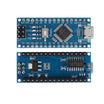
- Arduino Nano V3.0 - reads the sensor output and controls the relay.
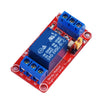
- 1-Channel 5V Relay Module - switches a lamp or other load when motion is detected.
- HC-SR501 PIR Sensor - optional, for the combined "AND both" approach.
External
- USB cable - to power and program the Arduino Nano.
- A multimeter - for measuring trigger voltage if desired.
- Optional: solder + iron - for tuning pads on the RCWL-0516.
Note: The RCWL-0516 accepts 4 to 28 V on VIN and outputs a 3.3 V digital signal on OUT. OUT can be read by common microcontroller GPIO inputs.
Step-by-Step Guide
Step 1 - Understand how microwave radar motion detection works
Goal: Know what the RCWL-0516 is measuring so you can place and tune it correctly.
What to do: The RCWL-0516 contains a 3.18 GHz oscillator that continuously emits a low-power microwave signal. The board listens for the echo. When something moves (any moving object, not just warm bodies), the reflected wave shifts in frequency due to the Doppler effect, and an onboard comparator pulls the OUT pin HIGH for about 2 seconds.
Expected result: You understand why it can trigger through thin materials and why it can detect non-human motion.
Step 2 - Wire the RCWL-0516 to the Arduino Nano
Goal: Power the sensor and bring its digital OUT signal into the Arduino.
What to do: Make the connections below. This uses only power, ground, and one digital input pin.

Wiring map:
RCWL-0516   Arduino Nano
VIN     ->  5V (works from 4-28V)
GND     ->  GND
OUT     ->  D2
3V3     ->  not connected (or sense 3.3V out)
CDS     ->  optional photoresistor for "only at night"
Expected result: The RCWL-0516 is powered and its OUT pin is available on Arduino digital pin D2.
Step 3 - Upload the Arduino sketch to switch a relay on motion
Goal: Turn a relay on when motion is detected, then turn it off after a timeout.
What to do: Upload the sketch below. It reads the RCWL-0516 on D2 and drives a relay module on D7. The relay shown is active LOW (LOW turns the load on).
Code:
const int RADAR = 2;
const int RELAY = 7;
unsigned long lastTrigger = 0;
const unsigned long HOLD_MS = 30000;  // keep light on for 30s

void setup() {
  pinMode(RADAR, INPUT);
  pinMode(RELAY, OUTPUT);
  digitalWrite(RELAY, HIGH);   // active LOW
}

void loop() {
  if (digitalRead(RADAR) == HIGH) {
    lastTrigger = millis();
    digitalWrite(RELAY, LOW);  // light on
  } else if (millis() - lastTrigger > HOLD_MS) {
    digitalWrite(RELAY, HIGH); // light off after timeout
  }
}
Expected result: When motion is detected, the relay turns on and stays on. After no motion for 30 seconds, the relay turns off.
Step 4 - (Optional) Tune behavior using the solder pads
Goal: Adjust hold time, range, and day/night behavior if your application needs it.
What to do: On the back of the module there are solder pads labeled C-TM, R-GN, C-DS, and R-CDS. Bridging or adding components changes behavior.

- C-TM: add a capacitor here to extend the trigger hold time from about 2 seconds to up to about 10 minutes.
- R-GN: change a resistor here to lower the detection range (useful in small enclosures to reduce false triggers from distant motion).
- R-CDS / CDS pin: wire a photoresistor here to disable detection in daylight for a "night only" motion build.
Expected result: The sensor behavior better matches your environment (time on, range, and optional daylight lockout).
Step 5 - Know where the RCWL-0516 beats PIR
Goal: Choose the right sensor for the job and avoid surprises during installation.
What to do: Use the RCWL-0516 when you need motion detection in situations where PIR commonly fails:
- Through walls: drywall, plywood, and even brick to about 7 m. Mount the sensor inside an enclosure or behind a wall; it can still detect motion.
- Behind glass: PIR typically cannot detect through glass; microwave radar can.
- Cold rooms: PIR can struggle when body heat contrast is reduced. Microwave radar does not depend on temperature contrast.
- Through clothing / blankets: microwave energy can pass through fabric, which can be useful for occupancy sensing in upholstered furniture.
Expected result: You place the sensor where its strengths matter most.
Step 6 - Know where PIR still wins
Goal: Understand the trade-offs so you can avoid false triggers and reduce power draw.
What to do: Keep PIR in mind when you specifically need these advantages:

- Detecting humans only (the RCWL-0516 can trigger on plants, ceiling fans, washing machines, and other moving objects).
- Battery-powered builds (RCWL-0516 draws about 3 mA continuously; PIR can sleep below 100 µA).
- Tighter directional fields of view (PIR is typically around a 120 degree cone; RCWL-0516 is closer to omnidirectional).
Expected result: You can decide if radar, PIR, or a combined approach is best for your project.
Step 7 - The pro move: AND both sensors
Goal: Reduce false triggers by combining two different sensing methods.
What to do: Combine an RCWL-0516 with an HC-SR501 PIR. Trigger the lamp only when both outputs are HIGH at once. PIR confirms it is likely a warm body, and microwave confirms there is real motion.
Expected result: False triggers drop significantly compared to using either sensor alone.
Conclusion
The RCWL-0516 is a strong choice any time you want motion detection through plastic, behind glass, or in colder environments where PIR can struggle. Wired to an Arduino Nano, its simple digital output makes it easy to trigger a relay for lights and other loads.
Want the exact parts used in this build? Grab them from ShillehTek.com. If you want help customizing this project or building something for your product, check out our IoT consulting services.



.png?v=25000753014097803521791168436)

.png?v=68677308723310773341791168436)


