Overview
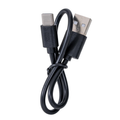
A short USB-A to Micro-USB cable in 0.5 m (1.64 ft) length — the workhorse cable for older Android phones, ESP32 / ESP8266 development boards, NodeMCU, the Raspberry Pi Zero W and Zero 2 W, Bluetooth speakers, dash cams, e-readers, and a long list of accessories from the 2010-2020 era. The shorter length keeps your bench and travel kit tidy without sacrificing the ability to charge or program from any host PC, hub, or USB wall adapter.
The cable supports USB 2.0 Hi-Speed for data and is rated for the standard 5V power profile from any USB-A source. Foil + braid shielding keeps EMI low for clean serial-over-USB programming on ESP and similar microcontrollers.
At a Glance
Connector B
Micro-USB B male
Data Speed
USB 2.0 (480 Mbps)
Best For
ESP32, Pi Zero, older Android
Specifications
| Parameter |
Value |
| Cable Length |
0.5 m / 1.64 ft |
| Connector A |
USB Type-A male |
| Connector B |
Micro-USB B male |
| USB Standard |
USB 2.0 |
| Maximum Data Rate |
480 Mbps (Hi-Speed) |
| Power Rating |
5V, up to ~2 A from USB host |
| Conductor |
Tinned copper |
| Shielding |
Foil + braid |
| Jacket |
PVC |
| Operating Temperature |
-20°C to +60°C |
Use Cases & Compatibility
Micro-USB has been the standard small-form-factor USB connector since the early 2010s, and it's still on a huge number of devices. If your device has a small, slightly-trapezoid USB port that's not the symmetrical USB-C oval, this is your cable.
| Device |
Notes |
| ESP32 / ESP8266 DevKit boards |
The classic dev-board cable. Power + USB-CDC programming. |
| NodeMCU (ESP-12E) |
Standard programming and power cable. |
| Raspberry Pi Zero W / Zero 2 W |
The Pi Zero family uses Micro-USB for power; data USB is on a separate Micro-USB OTG port. |
| Arduino Nano (newer clones with Micro-USB) |
Newer Nano clones and the Nano Every use Micro-USB rather than the legacy Mini-B. |
| Older Android phones (~2012-2017) |
Charging and data sync. |
| Bluetooth speakers, headphones |
Common charging port. |
| E-readers (Kindle Paperwhite older gens, Kobo) |
Charging port. |
| GoPro Hero 3-7 |
Earlier GoPros used Micro-USB before switching to USB-C. |
| USB hubs / dongles requiring Micro-USB power |
Powered hubs, splitters. |
Tip: Micro-USB is keyed — the connector only fits one way. If the plug doesn't slide in easily, flip it over and try again rather than forcing it. Forcing a Micro-USB plug in upside-down is the most common cause of damaged ports on dev boards.
Frequently Asked Questions
Can I program my ESP32 / NodeMCU through this cable?
Yes — this is a full data + power cable. Plug it into the dev board's Micro-USB port and into your PC's USB-A. The board's onboard CP2102 / CH340 USB-UART will appear as a serial port, and tools like Arduino IDE, esptool, PlatformIO, and Thonny will see it.
Why does my Pi Zero have two Micro-USB ports?
One is power (PWR IN), the other is USB On-The-Go (OTG). Use this cable on the PWR IN port to power the board from a wall adapter, and on the OTG port if you want to connect a keyboard or program it from a PC. They look identical — check the silkscreen labels.
My ESP32 randomly resets when I run a Wi-Fi-heavy sketch.
Wi-Fi transmit pulls bursts up to ~250 mA. Some thin or low-quality cables drop voltage too much under that load. Try a different USB port (skip front-panel ports on a desktop), use a powered USB hub, or use an external 5V supply to the VIN pin. This 0.5 m cable's short length minimises voltage drop, but a flaky USB host port is the most common cause.
Is this the same as Micro-USB 3.0?
No — this is standard Micro-USB B (sometimes called Micro-B). Micro-USB 3.0 (Micro-B SuperSpeed) has an extra connector segment on the side and was used on some external hard drives in the early 2010s. The two connectors are physically incompatible at the device side.
Will it charge my phone?
Yes, on any phone with a Micro-USB port. The 0.5 m length is convenient for car chargers, power banks, and USB-A wall warts.
Why does my Micro-USB plug feel loose in the device?
Micro-USB ports wear out over years of plug-unplug cycles. The plug itself is fine; if a board's port is loose, that's a common end-of-life symptom. A short cable like this puts less mechanical stress on the port than a long, dangling one.